


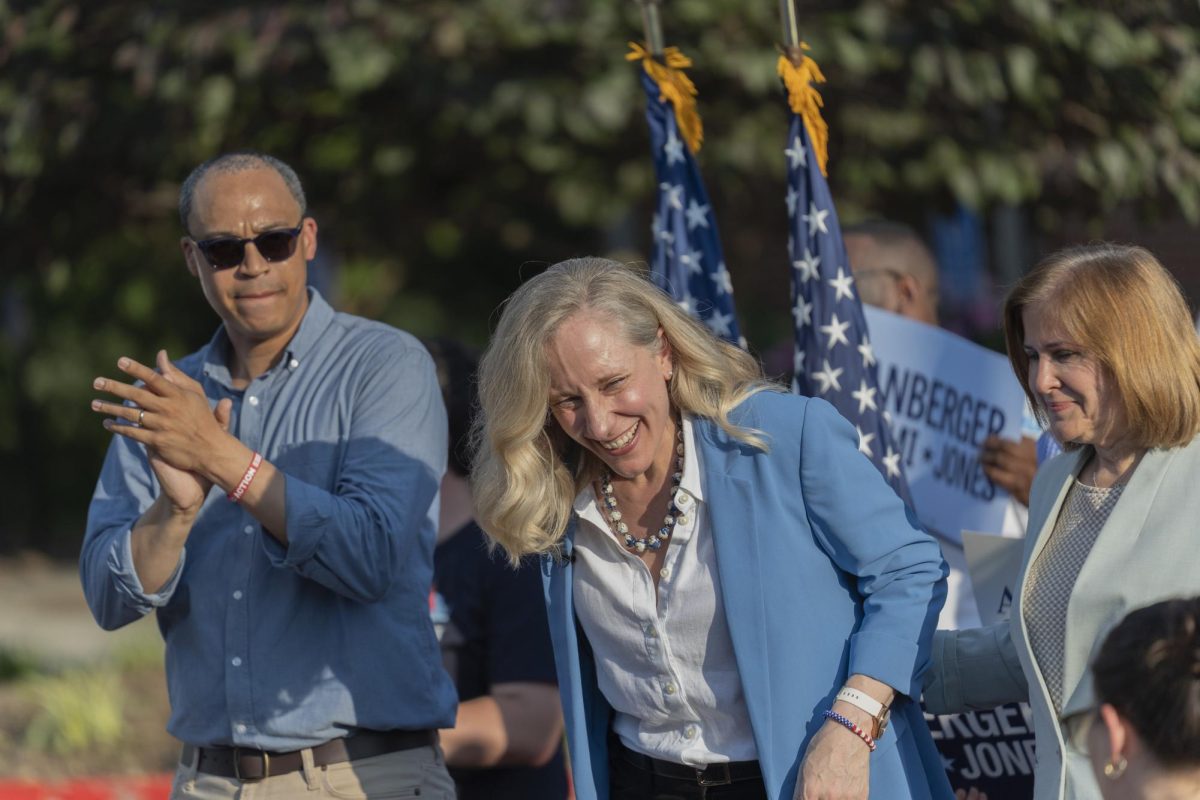
Across Virginia, Democrat Abigail Spanberger flipped 15 localities in the governor race that had gone red in 2021. Every locality across the state shifted to the left at the gubernatorial level, according to the Virginia Public Access Project.
However, Rockbridge County remained red, reelecting both Republican incumbents to the House of Delegates.
Terry Austin won reelection as the delegate for the City of Lexington and southern Rockbridge County, while Ellen Campbell retained her seat representing northern Rockbridge County.
For the downballot races in Rockbridge County, Republicans did not fare as well. Many independent candidates were elected to local positions.
In Rockbridge County, Republican J. Toria Brown lost to Jay Lewis in a three-way race for Walkers Creek supervisor. Lewis won with 35% of the vote. Independent Steven Hart won the election for Kerrs Creek supervisor with 64% of the vote. Sheriff Tony McFaddin won with 62% of the vote, marking his first election victory after being appointed sheriff at the end of last year.
All other local Lexington and Rockbridge offices went uncontested.
Pre-election polling suggested a tight race for governor, but Governor-elect Spanberger’s margin of victory, as well as the results in the lieutenant governor and attorney general contests, were much larger than expected on Nov. 4.
Spanberger, a Democrat who previously served in the House of Representatives, received 57.3% of the vote, while Republican Winsome Earle-Sears, the incumbent lieutenant governor, received 42.4%. Despite turnout being down by 1.5% from 2021, Spanberger received over 1.9 million votes, the most in history for a Virginia gubernatorial candidate.
Aggregate polling on Wikipedia correctly estimated Earle-Sears’s share of votes but underestimated Spanberger’s support, putting her at just 52.5%.
A YouGov poll conducted between Oct. 17-28 was the only one to accurately predict the 57%-42% results.
Republican John Reid received 44.3% of the vote in the lieutenant governor’s race, outperforming Earle-Sears by about 2 points. But Democrat Ghazala Hashmi prevailed with 55.4% of the vote.
Aggregate polling significantly underestimated Hashmi’s performance, projecting a 48.9%-44.3% win. The closest poll came from A2 Insights, which on Oct. 24–26 predicted Hashmi at 53% and Reid at 45%.
Polls predicted the attorney general’s race would be the most competitive, even before the leak of violent text messages sent by former delegate Jay Jones, a Democrat, in 2022. But the polls once again failed to accurately predict the outcome of the race.
The text messages were leaked on Oct. 3, and nearly every poll afterwards showed Miyares in the lead. However, between Oct. 30 and Election Day, the race drew closer. Polls from Quantus Insights and The Trafalgar Group showed the candidates tied, and another two polls from Emerson College and Insider Advantage showed Jones in the lead by 2%.
Jones won the election with 52.8% of the vote, while the incumbent attorney general, Republican Jason Miyares, received 46.7%. Aggregate polling estimated that Miyares would win with an average of 47.1% of the vote, while Jones was estimated to receive 45.6%.
The closest poll to predict the outcome after the leaked text messages was conducted by State Navigate from Oct. 17-20, with Jones predicted to receive 50% of the vote and Miyares getting 45%. Miyares lost despite outspending Jones on advertisements by nearly $10 million.
All 100 seats of the Virginia House of Delegates were up for election, and there were plenty of upsets. Democrats were largely expected to maintain control of the chamber, but most estimates predicted that only nine seats would flip blue.
Democrats’ record fundraising helped flip 13 seats, giving the party a 64-36 House majority, three seats shy of a supermajority.
A supermajority in the Virginia House of Delegates would mean that any vetoes enacted by the governor could be overturned, making it harder for the governor to stop legislation not aligned with their agenda.
According to the Virginia Public Access Project, Democrats flipped seven seats in competitive districts and six seats in lean-Republican districts. Five of the lean-Republican districts Spanberger won had backed Donald Trump in 2024, except District 73, which Kamala Harris carried by 0.6%. Republicans did not flip any seats.
Democrats employed a strategy of running candidates in all 100 House of Delegates Districts, which led to some races that were closer than expected. In House of Delegates District 69, Republican Chad Green won in 2023 with 91% of the vote after facing no opponents.
This year, Democrats flipped District 69, with Mark Downey receiving 49.7% of the vote, compared to Republican incumbent Chad Green’s 46.6%. Valerie Beverly, an independent candidate, received 3.5%.
The statewide results paint different pictures ahead of the 2026 midterms. Looking just at Spanberger’s margin of victory, House District 1 could be labeled a competitive seat, given that Spanberger won with 51% of the vote in a district that Republican incumbent Rob Wittman won by 13% in 2024. However, Hashmi lost the total vote count by 3%, and Jones lost by 9%.
The results in House District 2 tell a different story. Republican incumbent Jen Kiggans won in 2024 by a margin of 4%. But in 2025, Spanberger won the district by 8%. Hashmi won by 3%, and Jones lost by 1%, teeing up a fierce battle for this district.
If Democrats are successful in redrawing the congressional maps in the General Assembly and voters approve the suspension of the independent redistricting committee before the 2026 elections, Virginia could see wider margins of victory in congressional races for Democrats than currently expected.
Looking well ahead to 2027, all 100 House of Delegates offices and 40 State Senate offices will be up for reelection. It will take a monumental effort by Democrats to retain all, especially considering that six of the seats are in lean-Republican districts.


