


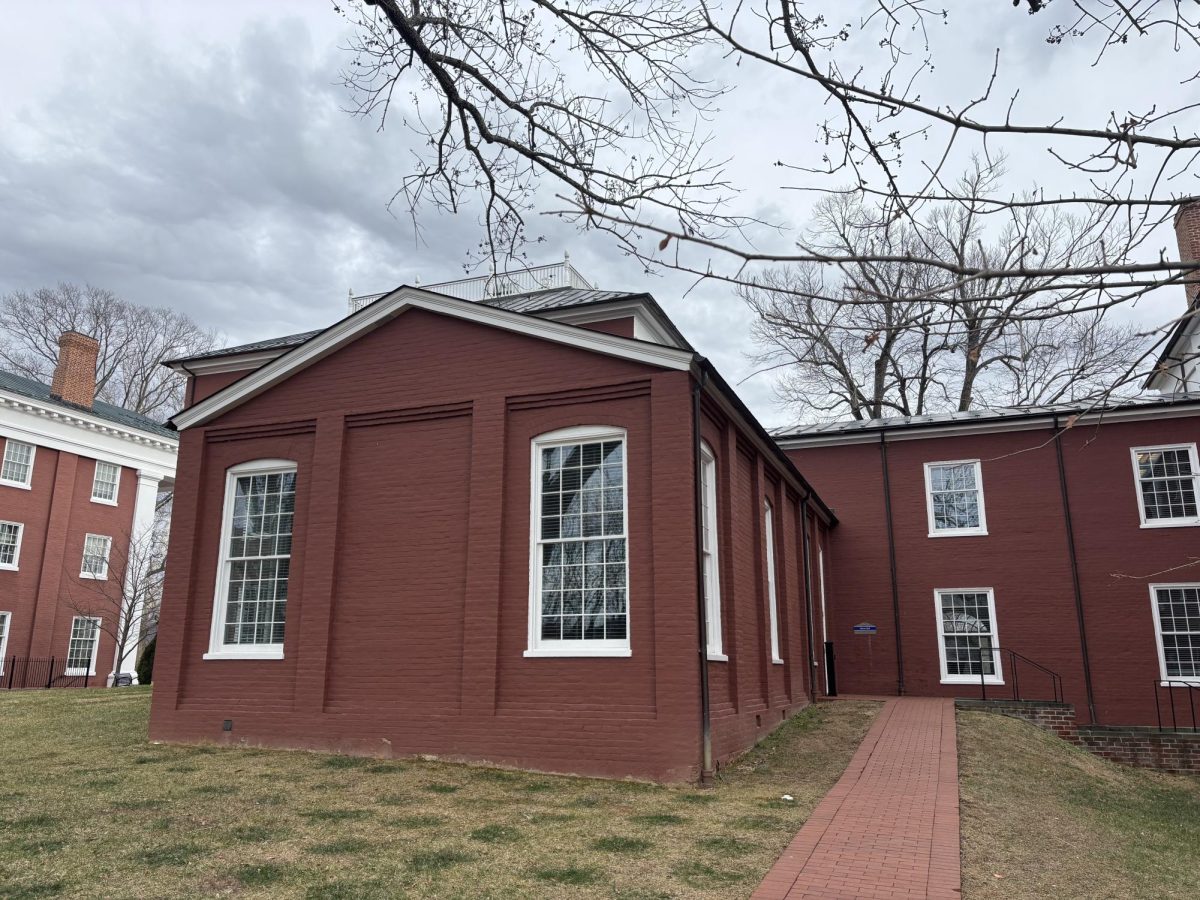
On a late Friday afternoon, as the last sunbeams cross the windows of a classroom in Chavis Hall, Hung Chu, ’19, is still working through challenging math problems with his students. His eyes stay fixed on the chalky numbers on the board, bright with enthusiasm.
The academic path of Chu, a new assistant professor of mathematics at Washington and Lee, began thousands of miles away in Hanoi, Vietnam. In 2015, he attended W&L as an international student, majoring in mathematics and economics.
After graduating, Chu completed a Ph.D. in mathematics at the University of Illinois at Urbana-Champaign in four years, then spent two years as a postdoctoral researcher at Texas A&M University.
Nearly a decade after arriving at Washington and Lee, Chu returned to his alma mater last semester as a tenure-track professor. This homecoming brought him back to the building where, in his first-year calculus II class, Professor Kevin Beanland had motivated him to major in mathematics.
“I wanted to come back because I feel grateful for the support that I received when I was a student,” Chu said. “And I want to pay it forward.”
Beanland said he still recalls how Chu stood out in the class for his precision and dedication, calling him “one of the best calculus students” he ever taught.
The turning point for Chu came during his sophomore year, when he joined Beanland’s W&L Summer Research Scholars (SRS) project on Banach space theory. The program revealed not only Chu’s raw talent but also his persistence and passion for solving difficult math problems.
Beanland recalled giving Chu a problem on Schreier spaces that had been open since 1989, an unusual challenge for a student who had not taken his real analysis class yet.
Months later, after thoroughly studying research papers and wrestling with the question, Chu unexpectedly emailed Beanland a draft proof. When Beanland pointed out an error, Chu returned with an idea to fix it within three days, showing no sign of discouragement.
Professor Elizabeth Denne, Chu’s linear algebra instructor, said he had the sharpness and intelligence to become a mathematician, but it was his willingness to “push further” that set him apart.
Recognizing Chu’s potential, Beanland and other faculty encouraged him to apply to the SMALL Undergraduate Research Project program at Williams College and wrote recommendations for his application.
Beanland said Chu thrived in the program and eventually became a “professor” to other students. He continues to collaborate with that research group to this day.
“I do not want to push students into paths they do not really want,” Beanland said. “But with Hung, it was clear. He loved the subject, had the talent and work ethic and genuinely wanted this life.”
Professor Gregory Dresden, who taught Chu in a real analysis class, said he noticed the same trajectory. Dresden said Chu was already doing more than most undergraduates, from analyzing research papers to exchanging ideas with professors to delving into math problems beyond the curriculum.
With all these experiences in SRS and SMALL, and under his professors’ mentorship, Chu said he became firmer of his commitment to a mathematics profession.
“The more I did research, the more certain I felt that I wanted to be a professor,” Chu said.
As a young faculty member, Chu’s perspective on teaching is shaped by his time as a student. Drawing from memories of W&L professors being supportive towards him, Chu said he strives to continue that culture and stays present whenever students need help.
Chu said he also recognizes students’ anxiety about mathematics and works to challenge the myth that only “innately gifted” people can succeed.
“If my students have passion and put in enough practice, they can reach any level of mastery they want,” Chu said. “My job is to make that path clear and support them along the way.”
Eryk Chojnacki, ’26, who is majoring in economics and mathematics, has taken Chu’s real analysis course.
He described Chu as “trying to infect you with his joy of doing math” and credited Chu with deepening his interest in math by spending hours answering his questions and encouraging him not to give up.
Math major Kriya Shah, ’26, said Chu made the course less daunting by breaking down the material reasonably and shifting the class away from one-way lectures toward open and free discussions.
Kürşat Yilmaz, a visiting assistant professor of mathematics and Chu’s colleague, said Chu’s energy stands out most.
“Whether it is in the morning or late evening, Chu is always optimistic,” Yilmaz said.
Chu said tha for him student-professor interactions mean more than grades. They are part of a supportive community, one that he experienced himself as a student.
During his undergraduate years, Chu said he frequently spoke with professors and stayed in touch with them throughout graduate school. He said the transition from seeing them as professors to viewing them as colleagues felt strange at first. Soon, though, he saw it as an opportunity to continue learning from the people he admires.
Next summer, Chu will lead a remote SRS project with W&L students on Schreier-type sets. The topic involves counting sets of numbers that satisfy certain conditions and finding patterns in those counts. Beyond technical knowledge, Chu said he hopes students will gain “marketable” skills like critical thinking and problem-solving.
Looking ahead, Chu said he wants to keep improving as a professor.
“It is a never-ending process of learning,” Chu said. “It is like adding tools to your toolbox.”
He said he looks forward to developing courses in actuarial science, measure theory and functional analysis, aligning math with students’ career goals. In the long term, Chu said he sees his professional home remaining in Lexington, which he calls his “home in the U.S.”
Rather than remembering every class detail, Chu said he hopes his students will think of him as someone who “showed them the beauty of math and life.”


