


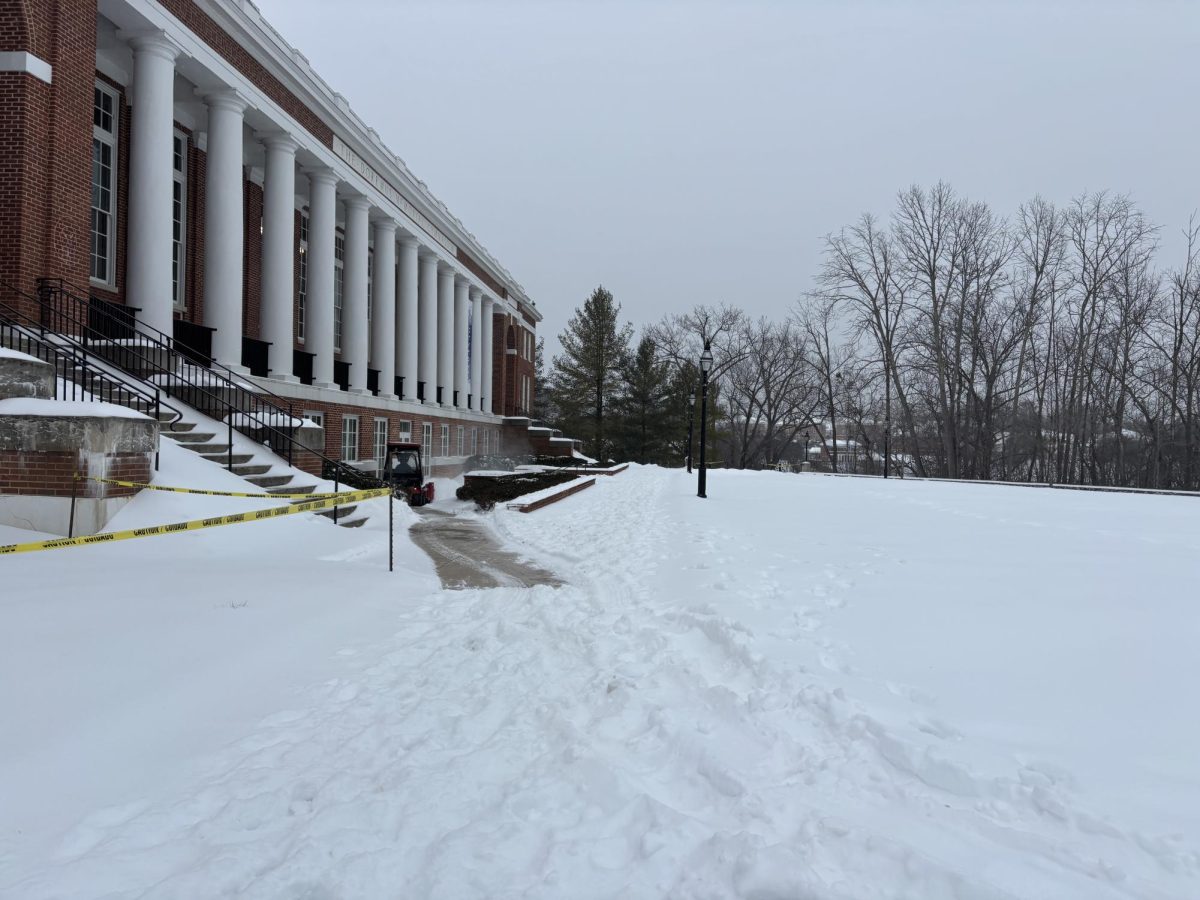
As students woke up to a snow-covered campus on Jan. 25, facilities workers had already completed a 10-hour shift removing snow. Some workers would go on to work another six hours.
Coming in during emergencies like a snowstorm is in the job description for all essential employees, said Kathleen Black, the grounds supervisor. Custodians, the grounds crew and employees working in HVAC, plumbing or carpentry are all considered essential, she said.
Workers who can’t make it to campus are required to use their combined time off, which includes time taken off for illness, vacation or other personal reasons, according to Washington and Lee’s employee handbook.
Black said there are about 85 essential employees. The Phi spoke to two of them. Both requested confidentiality for fear of losing their jobs.
“I just feel like it’s a bit of a failure in their system,” one of the employees said. “A lot of your housekeeping staff are women. It’s a lot they’ve been putting on women and people that aren’t really here to do that type of work. We’re here to take out the trash and clean your showers.”
For the storm that hit a week ago, workers were required to report to campus by 8 p.m. that Saturday and work through the night, finishing up work at 6 a.m. on Sunday.
“I was very frustrated. I couldn’t keep up,” said the second employee who requested confidentiality. “I’d get one house kind of straightened out and then go to the other one, and by the time I got that one straightened out, the other one was back to being a mess.”
The second employee said getting the job done by 6 a.m. wasn’t possible.
“In my opinion, they need to contract it out,” the second employee said.
After finishing the 10-hour shift, the second employee had to wait two more hours for a ride from a friend because the employee’s car was snowed in.
“I was exhausted. It was absolutely horrible,” the second employee said.
The second employee had to rely on family and friends for rides to and from work because the car was stuck for nearly four days.
“We just really do appreciate everybody’s hard work in a storm, especially of this magnitude,” Black said. “It’s just great that everyone was a team player in all of it.”
Black said that workers could take breaks to nap if they needed to. She said they could rest in their facilities’ trucks, come back to the shop or go to the Morris House, which was opened for employees’ use during the storm.
“I love my job. I love working here,” said the first employee, who requested confidentiality. “This snow removal thing is the only sticky part of my job that I don’t really agree with.”
Both workers said they understand they’re clearing the snow to keep students safe but worry about their own safety, too.
“There’s also a safety issue, you know, expecting people to be driving during the hours that it’s going to be snowing and expecting them to get here to do all that manual labor,” the first employee said. “And how are they getting home safely?”
Black said she works with the senior lead groundskeeper and the director of operations and maintenance to decide when essential employees come in.
“Obviously, we’re always worried about the safety of individuals,” Black said. “We’re constantly watching the weather. A lot of times we like to come in right as the storm is getting ready to start.”
Black said the most recent storm’s effects lasted all week.
“That storm was different than any storm that we’ve had in the last several years because the first two to three inches was a really nice powder,” Black said. “And then about 7 a.m. Sunday, the sleet started, and that’s pretty much what is on top.”
Employees continued to work outside throughout the week, they said, including clearing snow for fraternity parties in Davidson Park this past weekend.
“The snow is two and a half feet deep at the bottom of the stairs,” the first employee said. “And they were having to bust it up with like farm equipment and carry it up the stairs to find a place to put it.”
The workers said snow removal distracts from the jobs they were hired to do.
“How are we to be expected to be doing our daily duties right when we are outside shoveling? It’s not a ten-minute job,” said the second employee who asked for confidentiality.
“It’s just a very broken system,” the first employee said, “and I think the university could do better.”


