


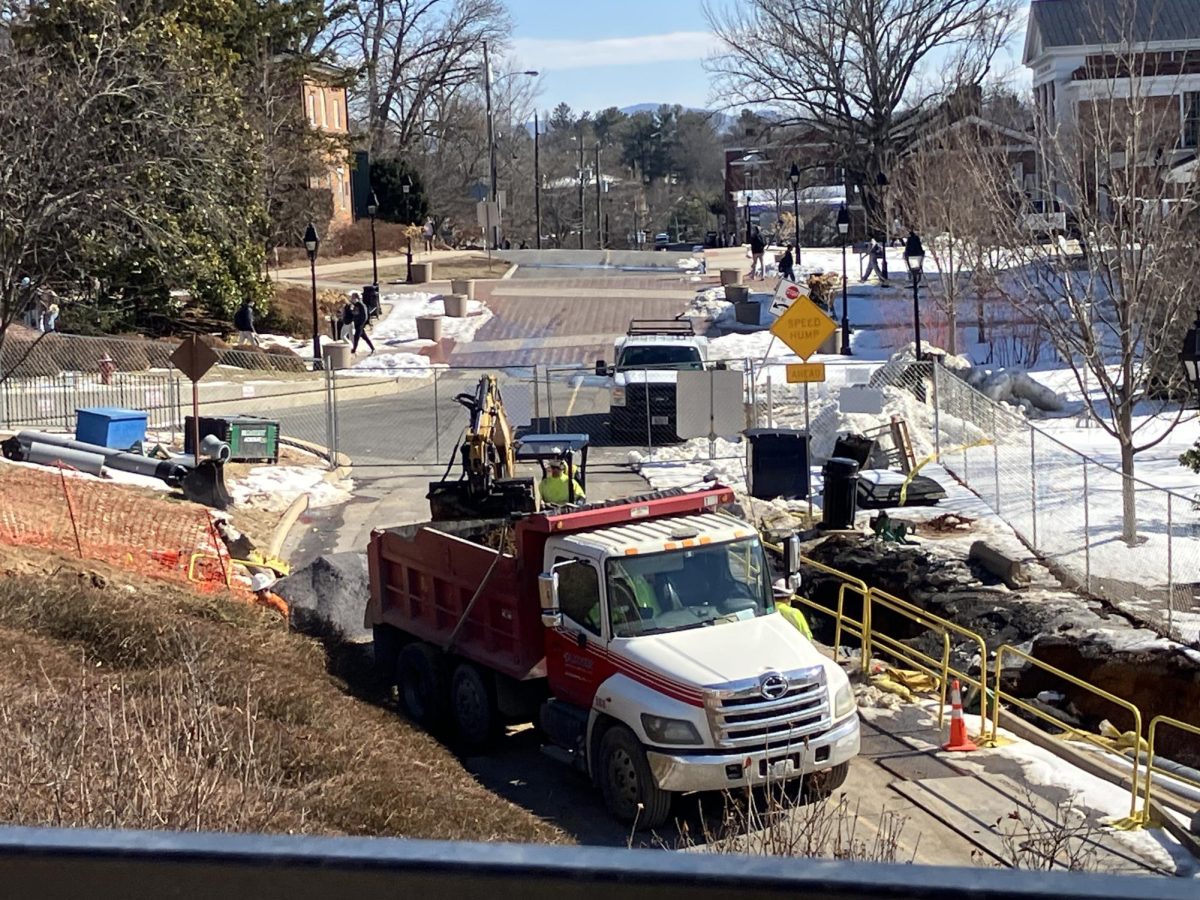
West Washington Street is expected to reopen in April after months of being closed due to a pipeline installation project. The street was set to be closed through November, according to an email from Will Dudley, the president of Washington and Lee University, last September.
“There was a partial reopening of the section between Early-Fielding Way and Nelson Street in November, which allows the flow of two-way traffic along Early-Fielding Way to the Gaines Hall parking,” said Brendan Perry, an engineer who works on the project.
The construction began in August as part of the university’s campus utility infrastructure project, a multi-phase effort to reduce the university’s carbon footprint and further sustainability efforts. The first phase focuses on West Washington Street and the area next to Graham-Lees Hall.
About 80% of the work for phase one is completed, Perry said, including the installation of new underground heating and cooling lines that connect multiple campus buildings. All of the pipelines are now installed.
As part of the project, construction workers are connecting low-temperature hot water piping to various campus buildings, such as the Williams School, Gaines Hall, Elrod Commons and Huntley Hall. The new pipes will reduce the amount of energy the old pipes lose during distribution. The old pipes were too narrow to handle the needed water capacity.
Perry said the project has not encountered any major delays. He said West Washington Street has always been expected to reopen for traffic in April.
“There’ll be several high-elevation phases,” Perry said. “Phase one will actually continue on out until 2030.”
The project also focuses on making improvements to energy consumption and landfill materials management. Some of these improvements include setting a minimum and maximum thermostat range, requiring fuel reduction in grounds maintenance and increasing recycling and compost efforts.
“Because the university is executing this upgrade in a way that considers the best long-term performance, maximizing efficiency and environmental benefits, it is also very exciting from a sustainability perspective,” said Jane Stewart, the university’s director of sustainability.
After April, most of the construction will be completed at the campus heating and cooling plant at 255 E. Denny Circle, causing minimal disruptions to campus, Perry said.
The utility infrastructure project is part of the campus master plan, which aims to modernize the university’s aging infrastructure and make the university carbon-neutral by 2050.
“By the end of phase one, we expect to be making significant progress on reducing the university’s carbon footprint,” Perry said. “We think that the percentage reduction will be around 30 to 35%.”
Emma Marvelli, ’27, said she appreciates what the university is doing.
“I believe that by revamping spaces on campus, they are giving students the best opportunity to succeed,” she said.


