


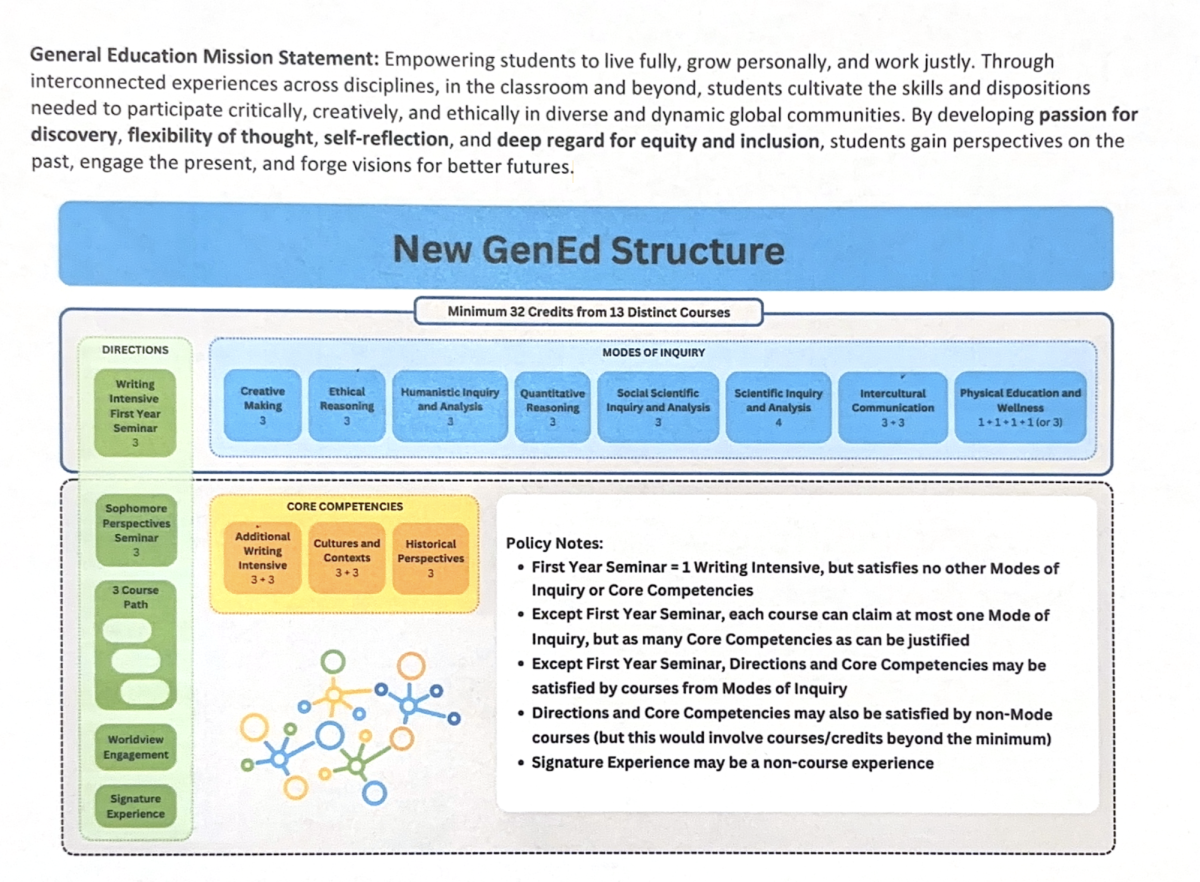
Students in the class of 2031 will be required to complete a new set of general education requirements, Professor Paul Gregory said. The new system will be implemented in the fall of 2027, which is one year after the original deadline, according to previous reporting by the Ring-tum Phi.
The General Education Implementation Committee began revamping general education requirements in 2018, when faculty recognized that the university’s current foundational requirement system needed substantial improvements, according to previous reporting by the Phi.
“The old system is super traditional, just throwing things together in the name of liberal arts,” said Paul Gregory, co-chair of the General Education Implementation Committee and professor of philosophy.
The primary goal of the new Gen Ed system is to create a balanced, intentional path for incoming students, said Gregory.
The new curriculum will require students to fulfill at least 32 credits from at least 13 distinct courses across eight “modes of inquiry.” Students will also need to satisfy varying amounts of credit from integrations such as “Historical Perspectives,” “Writing Intensive,” and “Cultures and Contexts” courses.
Although the original implementation date was set for fall 2026, the complex revision process has taken longer than anticipated, delaying the projected rollout, Gregory said.
Intense conversations with committee members, input from department heads and checks against external accreditation standards have all extended the refinement process, Gregory said.
“It’s long overdue,” said Bob Stewart, professor of cognitive and behavioral science. “It’s what faculty have been arguing for since 2004, 2005.”
Stewart said he believes the new gen eds will be less of a checklist students feel obligated to fill and more of a holistic undercurrent to their journey at the university.
The student experience is at the forefront of the restructuring process, said Gregory. The emphasis on skills-based learning rather than discipline-based learning will ensure students gain significant aptitude, not just take courses that fall under a particular area of study, he added.
An example is the “intercultural communication” requirement, which will replace the language requirement.
Instead of being able to test out of the language requirement, students will now take two courses of the same world language. A shift such as this enables students to truly engage with a foreign language.
The new gen eds also require that all credits be satisfied through on-campus courses to maintain a fair educational experience, Gregory said. Students will no longer be able to transfer credits from Advanced Placement classes or other college credit programs to satisfy general education requirements.
Kiera Charneco, ’29, used her AP English Language and Composition credit to skip intro-level WRIT 100 and move immediately into a 200-level creative writing course. She said she’s concerned that the new gen eds will take away opportunities like this for incoming students.
Anthony Fasuyi, ’29, who tested out of his language requirement and stopped taking French, expressed his regret for the decision.
“I wish I were encouraged to keep taking a language. Now I want to, but it feels like too much time has passed to restart,” he said.
The new gen eds aim to combat situations like Fausyi’s by encouraging students to continue seeking deep and meaningful educational experiences.
Also being implemented is a new “signature experience” requirement that requires students to go “beyond the classroom to an outward-facing experience, whether that be summer research or an internship,” Gregory said.
Embedding the “signature experience” in the curriculum helps to ensure that all students are aware of the range of initiatives available to them, he said.
“High-impact experiences tend to be unequally used by students,” Gregory said. “Now it will be more evenly distributed as they have foresight into the expanse of opportunities.”


Brendan Milton • Mar 11, 2026 at 11:58 pm
Once again, the administration completely neglects the interests of STEM students. FDRs are already extremely frustrating for us to complete. To be honest, if I were a prospective engineering student seeing the new requirements and being completely unable to place out of them, there is no chance I would even consider going here over an institution that takes my career path seriously