


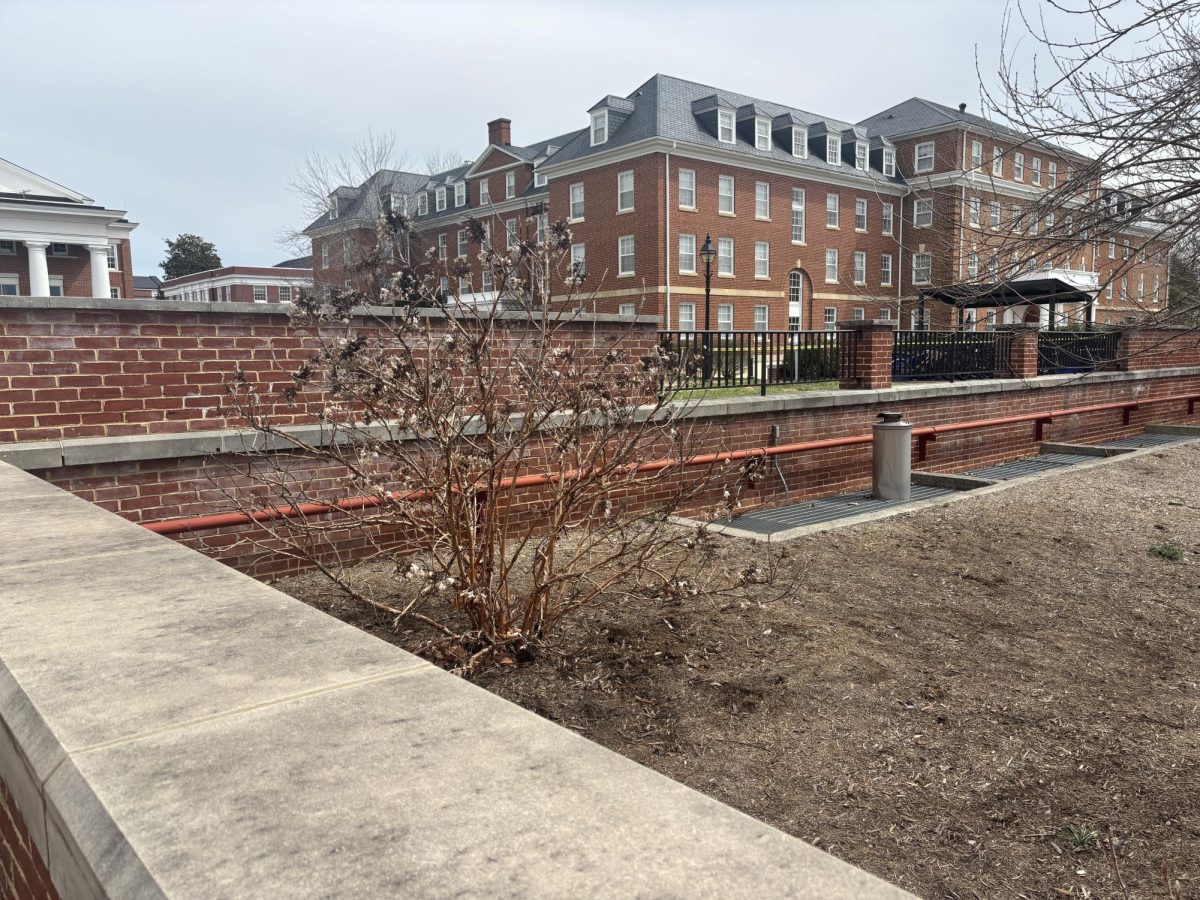
Walk past the gymnasium on the lower end of campus and you might notice a stretch of insulated pipeline running along the ground. It does not look like much. But according to Jane Stewart, Washington and Lee’s director of sustainability, it is one of the most consequential things happening on campus right now.
The pipeline is part of a university-wide shift away from steam heating, a system that burns natural gas and leaks heat before it even reaches the buildings it is supposed to warm.
Replacing it is one piece of a larger effort that has already cut the university’s greenhouse gas emissions from energy by 74% since 2007. Stewart says the university is pushing toward an even more ambitious goal than it had publicly announced.
“We’re definitely looking at a much shorter timeline than 2050,” she said about the university’s goal to become carbon neutral.“We’re just making sure we’re confident in where we are before we put something out.”
For students focused on classes, extracurriculars and everyday life, sustainability work often ranks low on their list of priorities. But the choices being made right now by Stewart’s office about how this campus is heated, powered and built will define what Washington and Lee looks and feels like for the next generation of students.
Smarter Before Newer
When Washington and Lee joined the American College and University Presidents’ Climate Commitment in 2007, it pledged to reach carbon neutrality by 2050. Nearly two decades of steady progress have put that timeline within reach far sooner.
The biggest driver of that progress was a sustained effort starting around 2010 to ask, at every level of campus operations, whether energy was being used as efficiently as it could be.
About half of the university’s total emissions reductions have come from changes like smarter scheduling of heating and cooling systems, equipment upgrades and simply not running the air conditioning through the night.
“There tends to be a lot of emphasis in the media about future solutions, about technology. I just think it’s really valuable for people to know the huge amount of progress that is possible just by being a little smarter about things,” Stewart said.
The Williams School of Commerce, is the university’s first LEED Gold certified building, which means it has received a green building certification for energy efficiency and sustainable design building.
Its heat recovery chillers capture wasted heat from other campus buildings and redirect it to warm its own spaces. Stewart says initiatives like that matter more than it seems.
“That’s the key piece of any of these things,” she said. “Making sure that your operations match up with the intentions of the construction.”
Every new building on campus must meet LEED certification standards, a requirement written directly into Washington and Lee’s Climate Action Plan. To reach carbon neutrality, every new building cannot add to the energy load.
The Heat Problem
Most of the university’s remaining carbon footprint comes from the natural gas boilers at the central plant, which generate steam to heat buildings across campus. Steam heating is energy-intensive by design. It requires very high-temperature combustion, and a significant amount of heat is lost to leaks along the distribution pipes before it reaches its destination.
University engineer Brendan Perry has been leading an effort to replace the steam system with low-temperature hot water, a technology that has been successfully deployed in cold climates from Minnesota to Maine. It is more efficient than steam, loses less heat in transit and does not require the high-heat combustion that makes natural gas necessary.
Once the infrastructure is in place, the boilers can be switched to electric or geothermal power.
That infrastructure is already being installed. The pipeline near the gym is one piece of it.
The new system is already connected to Elrod Commons and the Williams School, which has the first heat recovery chillers on campus. The central plant itself is the eventual target.
“We should be seeing gains in the near term,” Stewart said. “And then ultimately a really dramatic change.”
The Solar Workaround
Getting renewable electricity onto campus required years of regulatory navigation. Virginia’s utility regulations limit how much on-site solar generation a retail customer of Dominion Energy is allowed to install. At the time Washington and Lee designed its electricity strategy, the cap sat at just one megawatt. The university’s needs are considerably larger.
The solution Stewart’s office developed took years of negotiation. The university partnered with a developer to build an offsite solar array that feeds power into the regional grid in roughly the same quantity the university draws out. It is a roundabout approach, Stewart said, but it was the option available under state law.
The Virginia Clean Economy Act requires Dominion to reach 100% renewable electricity by 2035. If that holds, the grid Washington and Lee draws from will eventually be free from fossil fuel on its own, meaning the university’s solar investment shifts from a workaround into a net contribution.
What ‘Carbon Neutral’ Actually Means
Behind the scenes, the university is also reconsidering what carbon neutrality actually means.
The national commitment W&L signed requires neutrality in Scope 1 (direct emissions from owned sources, like boilers) and Scope 2 (purchased electricity), and a subset of Scope 3 emissions (primarily transportation). But Scope 3 covers a much broader range of activities: student travel to and from campus, commuting, waste and purchased goods.
The university is now debating whether its definition of neutrality should encompass all of Scope 3 as well. Stewart said the distinction matters because it changes the scale of the challenge significantly and shapes how the university’s progress compares to other institutions.
Stewart said several well-known peer institutions have declared carbon neutrality while reporting on-campus emissions higher than W&L’s current levels. The difference is often carbon offsets, payments to fund emissions reductions elsewhere that balance the books on paper.
“We want to make sure that we are never doing something just to check the box. It has to have independent value,” Stewart said. “If all the reporting standards went away, would we still be glad we made this investment?”
W&L does not rule out offsets entirely. At some point, Stewart said, emissions from student travel will likely need to be offset, because the university is not going to tell students not to come. But the emphasis has been on reducing actual emissions first, and being transparent about what remains.
In the Classroom and Beyond
Sustainability at W&L is not confined to facilities management. A national assessment called the STARS report, published by the Association for the Advancement of Sustainability in Higher Education, surveys academic programs across university campuses for sustainability-related teaching and research. When Stewart first conducted the survey for W&L after taking on the director role, the breadth of what she found surprised her.
“We have hundreds of courses on these topics, all across the disciplines,” she said. “There’s actually a huge amount of work being done. It just maybe hasn’t been visible.”
A faculty cohort launched this year, led by English professor Beth Staples and Earth and environmental geoscience professor Margaret Hinkle, is working to bring sustainability content into courses that are not explicitly about the environment.
An accounting class, for example, might use W&L’s own energy or waste data as a dataset for student analysis. The sustainability committee is also exploring whether course registration could include a notation identifying sustainability-related classes, making them easier for students to search.
A Model, or Something Better
When asked what it would take for W&L to become a national model for university climate action, Stewart pushed back on the framing.
“As soon as you say, ‘We’ve got best practices, we’re a model,’ you are no longer a model,” she said. “Because there is no institution that, at any point in time, has got it all figured out.”
What she described instead was a culture of accountability: publishing greenhouse gas data publicly and inviting scrutiny, maintaining an internal carbon price that factors the cost of emissions into budget decisions and sharing what works — and what does not — with peer institutions through statewide and national networks.
W&L is already recognized nationally for its composting program, and Stewart said she has presented the university’s solar project to Virginia peer institutions. Case studies on other initiatives are in the works.
“The point is not to be first or best, but to actually get it done. The best national model won’t be any one institution, but a practice of collaboration,” she said.


