


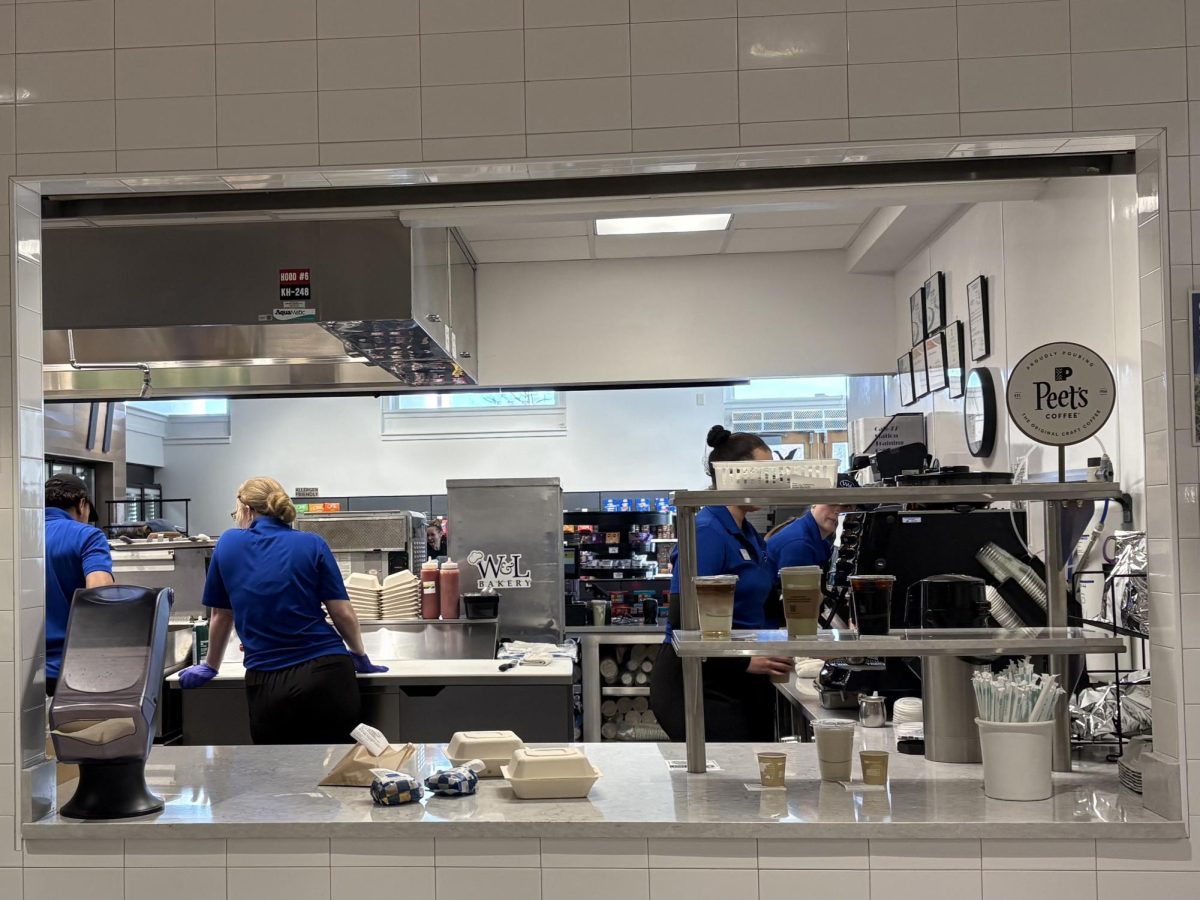
Washington and Lee’s dining locations have seen a large rise in sales since the mobile ordering system was introduced in the spring term of 2024, said Hannah Vozzo, assistant director of dining services.
Vozzo said Café 77 generates about $5,000 per day from mobile orders on weekdays. Mobile sales account for about a quarter of total sales at Tea House and Fireside, she said. At the E. Cafe, the number of mobile orders now surpasses in-store purchases.
Many students enjoy using the mobile ordering system for drinks.
“I like the idea of just being able to drop by and grab my drink on the way to somewhere else,” said Bethany Po, ’29.
Students also said they like mobile ordering because it allows them to skip the long lines during rush hour.
“It’s huge because Coop lines get really big,” said Olesia Soukhoveev, ’26. “If you just mobile order, it’s all ready. Huge time saver.”
But for dining services, mobile ordering during rush hour is chaotic, said Rosanna Wilhelm, Coop’s daylight supervisor.
“I think a lot of people assume, especially with the coffee system, that if they mobile order it will be ready when they get here,” Wilhelm said. “But we’re getting 50 to 60 tickets within 20 minutes some mornings.”
Wilhelm said mobile orders often sit on the counter for 30 minutes awaiting pickup, leaving no room for in-person orders.
“We don’t have the space to store the orders,” she said.
Fireside worker Millie Glick said she’s also experienced issues with a lack of counter space during rush hour.
“A lot of times, food will sit out for 20 minutes,” Glick said. “Sometimes we’re told to throw it out because it’s been waiting for so long. Then [students] get here and they’re upset.”
Some students said they want more customization when mobile ordering. While the app offers multiple-choice options, many students said they would like more ways to personalize their orders.
“If I could change one specific thing about the mobile ordering system, it would be the ability to order the Tea House specials and special syrups online,” Po said.
Soukhoveev also said she wants further customization.
“I always get an extra shot of espresso, but I can’t do that when I mobile order,” Soukhoveev said. “For Hillel, I always like to add a strawberry to my tropical passion smoothie order … but you can’t do that if you mobile order.”
But Vozzo said dining services won’t be adding a customization feature to the app for unification purposes and to avoid odd requests.
“Cohesion is important. Unity is important,” Vozzo said. “That’s why all of our standard drinks are available on [the app], but some of the specialty things you still have to order at the register.”
She added that she adapted the basic app to work for Washington and Lee, so there are possibilities for growth.
Vozzo said students have also raised concerns about discrepancies in ticket timing during rush hour.
“Coop is quite delayed for when you receive your ‘It’s ready’ text versus when it’s actually ready,” Soukhoveev said. “You just kind of have to always guess, so you never really know.”
Vozzo said the app’s algorithm automatically tells students there’s a long wait time when the number of mobile orders per hour exceeds a certain threshold. She said the actual pickup time is shorter.
“Those ticket times are really frustrating, and we’ve been back and forth with the app to try to make it more accurate,” she said.
Wilhelm said the mobile ordering system is a work in progress.
“It’s just going to take some tweaking,” she said.


