


Khruangbin’s discography is like all the great TV shows — you wait two years for the next season to drop and hope you haven’t lost interest in them. Only in this case, it’s a 40-minute album with 10 songs.
Their most recent album, “The Universe Smiles Upon You ii,” remixes their 2015 debut album “The Universe Smiles Upon You” — to fans, TUSUY.
If you’re disappointed by their past album and wish their new release gave more energetic material, would you complain if you were offered a free glass of wine? The longer you sip on Khruangbin, the sweeter the music tastes.
However, the trio’s recording process remains the same.
For “TUSUY ii”, the trio reunited at the original recording spot for “TUSUY”: a barn on lead guitarist Mark Speer’s family land. In a recent interview with Rolling Stone, Speer said they stuffed blankets between the cracks so the wind would not seep into the recording. They needed to be warm. Nothing is worse than hammering cold, metallic frets with frigid fingers.
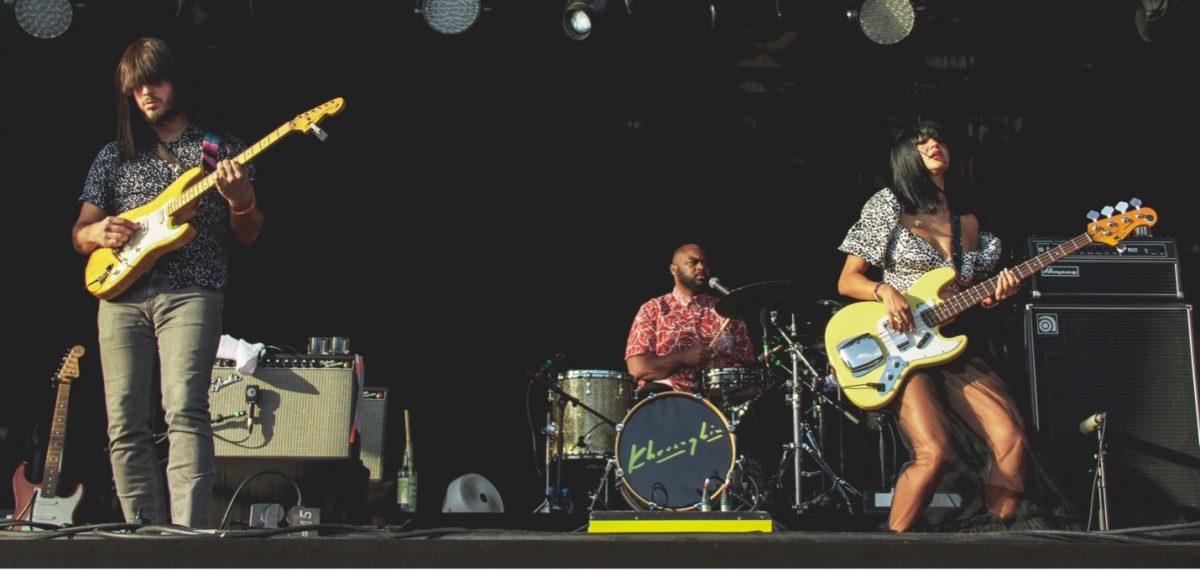
Few truly understand the band’s sound. And to understand, you must see them live. It’s bass and drums. They dominate the foreground while the lead guitar paints a background landscape with riffs and rhythms. Their studio albums do not emphasize these distinctions enough.
Together, they craft an experience.
This makes sense because Khruangbin is album listening. Albums create experiences. With few vocal tracks, Khruangbin emits color spectra to create an international setting. But how do you achieve an international setting with music? A musical airplane! Or, a Khruangbin, meaning “airplane,” in Thai.
Speer blends different styles and textures of music into classic Western chord sequences, from West African licks to disco rhythms to reverberating chorus tones. Most do not enter his realm except for Franco Luambo, or Ali Farka Touré and his son Vieux Farka Touré. Naturally, Khruangbin and Vieux Touré collaborated and released their album “Ali” in 2022.
Clearly, “Balls and Pins ii” demonstrates the band incorporating international influences. In the key of A minor, Khruangbin mimics a starry Arabian sky at midnight while chilled sands sift around your ankles.
Speer layers the music with a constant breeze; the “backbone,” Donald “DJ” Johnson, pats an EDM-esque rhythm, while bassist Laura “Leezy” Lee shifts between thick notes within the fret box. Will Van Horn contributes significantly to the album and this song, adding an atmospheric synth to virtually every song. He is the difference on this album.
Their hit “People Everywhere” should be an EDM staple. Check out their version at Stubbs, where they cover Crystal Waters’s house classic “Gypsy Woman (La Da Dee).” Their version at the Sydney Opera House also features a house version of “Balls and Pins” labeled “Shifting Sands,” a reference to the lyrics.
“People Everywhere ii” drenches the original album’s version in LSD. It’s a psychedelic soundscape with build-ups and delays. The more you listen, the more you hear. Van Horn and Spears turn this anthem into a studio production masterpiece. The song is “still alive!”
Songs like “Two Fish and an Elephant ii” and “Zionsville ii” illustrate Khruangbin’s musical zeal. In Buddhism, two fish and an elephant refer to freedom and happiness. Zionsville is a spiritual, free city.
While the original version lasts three and a half minutes, “Two Fish and an Elephant ii” explores a psychedelic spatial universe, with light, funky rhythms for more than seven minutes. A true revision.
The opening track, “Little Joe and Mary ii,” sets the tone for the album. Calm. The leading nylon guitar plucking eastern Asian melodies transports you to a Zen garden.
Many articles label the trio as a Thai funk group. Sure, the lead guitarist’s style is Thai-inspired, as seen in “Little Joe and Mary,” but not necessarily Thai-funky. Four simple instrument lines create a complex texture and make their music international — the dissonances and rhythms, not just Speers.
The nylon guitar replaces the album’s renditions of previous electric guitar leads, adding a Thai influence in “The Man Who Took My Sunglasses ii,” a crossover between the original and “Ha Fang Kheng Kan.” The chirping birds bring you back to a Zen garden and can also be heard in “August Twelve ii.” Van Horn’s organ raises emotions as Leezy guides Speer’s licks that snake around the bass line. The folksy build-up is the main difference in the song.
On “Dern Kala ii,” the acoustic guitar notably contrasts Speer’s electric guitar on “Dern Kala,” but it still screeches like a bird cruising into a setting sun, its rays blistering the pink ocean’s horizon.
The Thai phrase Dern Kala means “walking on coconut shells,” which refers to a traditional game where players walk on halved coconut shells strapped to their feet. A similar Sikh phrase, “Chardi Kala,” refers to a state of high spirits and resilience.
Khruangbin produces another feeling of atmospheric bliss on this track thanks to Van Horn’s soaring slide guitar. Leezy varies her rhythm as she rests on the second beat of the second two-beat measure. These subtleties expose the talented yet conservative bassist’s creativity. Usually, DJ toys with the rhythm in concert at the end “Dern Kala,” but Leezy does it the whole song.
She similarly lacks consistency on “White Gloves ii.” Her rhythmic pauses and repetitions flow naturally while the band follows her footsteps. The rest of the band is her landscape.
The final track, “Zionsville ii,” could be dedicated to Serge Gainsbourg and France chanson. Despite its upbeatness, it brings a sense of closure to the album. Van Horn’s organ places the quintessential classic French organ sound within a bedroom-pop song. Somehow this organ sound made it onto TikTok songs.
In a 2019 interview with Reverb, Leezy claims Serge Gainsbourg’s early recordings inspire her bass tone. Khruangbin also covered Gainsbourg’s “La Javanaise” in their album History of Flight. DJ’s fierce patting drives the song, and the other muffled and distorted instruments center themselves around the drums.
Khruangbin’s retrospection inspires introspection. The final track’s bittersweet tone seems to say goodbye to their first album and to all the hours spent in the cold barn in the early years. You could cry, but instead you just happily reflect on life while the Khruangbin flies to your ultimate destination.


