


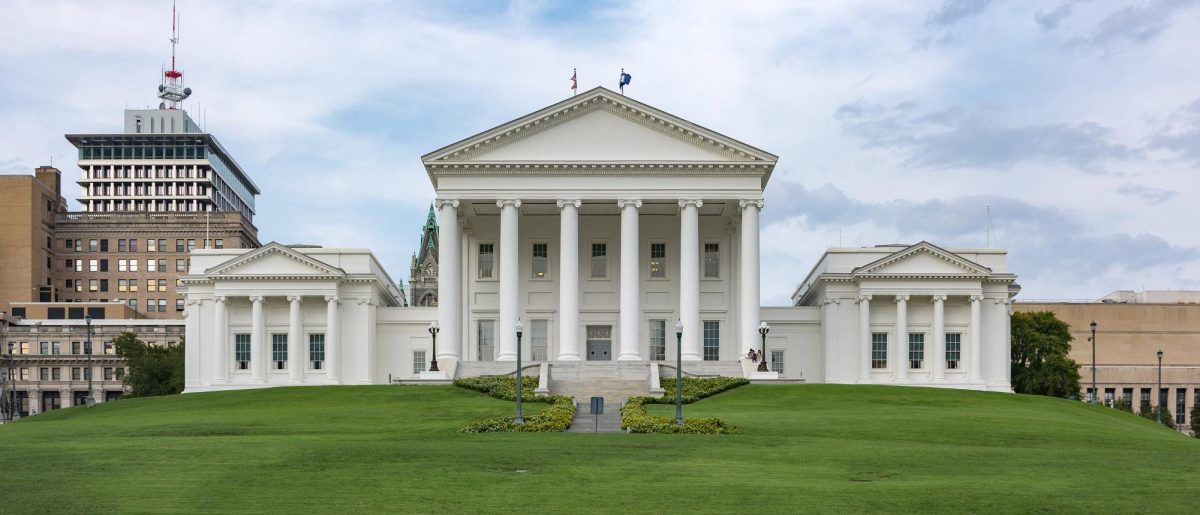
Virginia’s redistricting fight has gotten messy. The Tazewell County Circuit Court recently struck down Virginia Democrats’ efforts to redraw the state’s districts mid-decade, according to Cardinal News. This issue has rekindled a constant issue in U.S. politics: when do we reach the point at which political parties serve not to help us, but to work against the people?
In 2020, Virginia voters approved a constitutional amendment creating a bipartisan redistricting commission, according to the Virginia Mercury. The goal of this amendment was to take map-drawing away from politicians in an attempt to end gerrymandering. Both parties would work cooperatively to produce fairly split districts.
Ultimately, the 2020 commission failed to do its job. Republicans and Democrats were unable to agree on anything, and the Virginia Supreme Court ended up redrawing the lines, according to the Virginia Public Access Project.
Chief Judge Jack Hurley Jr. was apparently in a hurry with his ruling, too. According to Cardinal News, he sped up his decision specifically to beat a General Assembly vote that would have moved the case to Richmond. While this timing does raise some questions, it also shows how critical this case has become.
But according to the Mercury, Virginia’s General Assembly advanced a constitutional amendment that would allow the legislature to redistrict between censuses. Virginians would have voted on the amendment on April 21.
But Democrats had sidestepped both state law and their own procedures in rushing to redraw congressional districts before the midterm elections this November, according to Hurley.
Some Democratic lawmakers had even posted on social media about drawing maps that would create a 10-1 Democratic advantage in the state’s House of Representatives delegation, according to Cardinal News. These maps would have flipped four Republican seats.
Democrats say their effort followed all the legal requirements and that they’re responding to Donald Trump’s encouragement of Republican states to gerrymander their own districts, according to the Mercury. Texas complied, California responded and Virginia Democrats said they couldn’t sit by while Trump rigged elections elsewhere. In essence, they framed the whole thing as leveling the playing field on a national scale.
But that argument has inherent issues. The answer to more gerrymandering isn’t more gerrymandering. And Virginia voters had already said they wanted something different when they approved that redistricting commission in 2020. When the Democrats tried to draw partisan maps anyway, they ignored what voters had specifically asked for.
Hurley hit Democrats on multiple grounds, according to Courthouse News Service. He said they didn’t follow their own rules for amending the constitution, didn’t give proper public notice and tried to rush the process.
The legislature’s first approval of the redistricting amendment occurred on Oct. 31, just days before the November 2025 state House elections, even though early voting had already begun more than a month earlier on Sept. 19. Republicans said it violated the requirement that an election happen between the two legislative approvals needed for a constitutional amendment, according to Cardinal News.
The Republicans’ argument also focused on a law requiring constitutional amendments to be posted at every courthouse in Virginia for at least three months before voting. According to Cardinal News, Democrats dismissed this as an outdated holdover from 1902, when people traveled by horse to the county seat. State Senate Majority Leader Scott Surovell argued the provision had been removed from the 1971 constitution and only by oversight remained in the state code.
But the judge said the lack of required public notice was a fatal flaw.
Democrats tried to get ahead of the ruling by passing legislation to move any redistricting cases from Tazewell County to Richmond and to retroactively eliminate that three-month notice requirement. Judge Hurley called that out too, according to Cardinal News, questioning whether the legislature could retroactively change laws and whether moving the case violated the constitution.
Republican Senator Ryan McDougle highlighted it best in saying: “If the law was in place, you can’t come back and say, ‘Whoops….I’m going to go back and undo that.'”
Democrats are appealing and say they won’t be dissuaded from putting the issue to voters. They’ve accused Republicans of “court shopping” by filing in Tazewell County, a Republican-friendly area. Republicans counter that Democrats are the ones trying to shop for a friendlier court by moving the case to Richmond.
This situation has been made more difficult considering power balances and the history of the parties in trying to stake a greater claim. Republicans have drawn favorable maps when they’ve had power, and Democrats know this. So, why should they play nice when the other side hasn’t? The problem is that this logic leads nowhere good. Both parties push map-drawing further from anything fair, leading to the death of competitive districts, and voters end up with less meaningful choices.
Virginia’s current congressional districts are still the ones drawn by the state supreme court in 2021. The state now has six Democrats and five Republicans in the House. Democrats wanted to change that to 10-1. That’s not tweaking around the edges; that’s a complete overhaul designed to benefit one party.
Republican Senator Bill Stanley, one of the plaintiffs in the case, called the ruling “a complete victory for democracy and the rule of law.” According to Cardinal News, he said Democrats “didn’t follow the procedures basically from the beginning” and that the whole effort was “haphazard political gerrymandering.” Democrats responded that Republicans “can’t win at the ballot box” and are “abusing the legal process.”
Both sides have a point, which is exactly the problem. The current system doesn’t work. When redistricting gets kicked to politicians, politicians will draw the maps that help themselves. That’s not cynicism. It’s just reality. Virginia tried to fix this with a bipartisan commission back in 2020, and the commission failed horrendously. Now they’re back in court fighting over partisan maps, with both sides accusing the other of cheating.
What’s clear is that letting politicians draw their own districts creates an impossible conflict of interest. Democrats in Virginia had a choice: draw fair maps that might cost them seats, or draw maps that help their party but undermine the reform voters asked for. They picked the second option. One can call that pragmatic or call it cynical, but regardless, it’s hard to argue that it’s what voters wanted when they approved that constitutional amendment.
The case will likely drag on for months. Democrats successfully appealed to the Virginia Supreme Court, according to VPM. And the court won’t hear arguments until April 23, after voters have already weighed in on the amendment on April 21.
No matter what happens, someone’s going to feel like the system was rigged against them. And maybe that’s the real problem.


