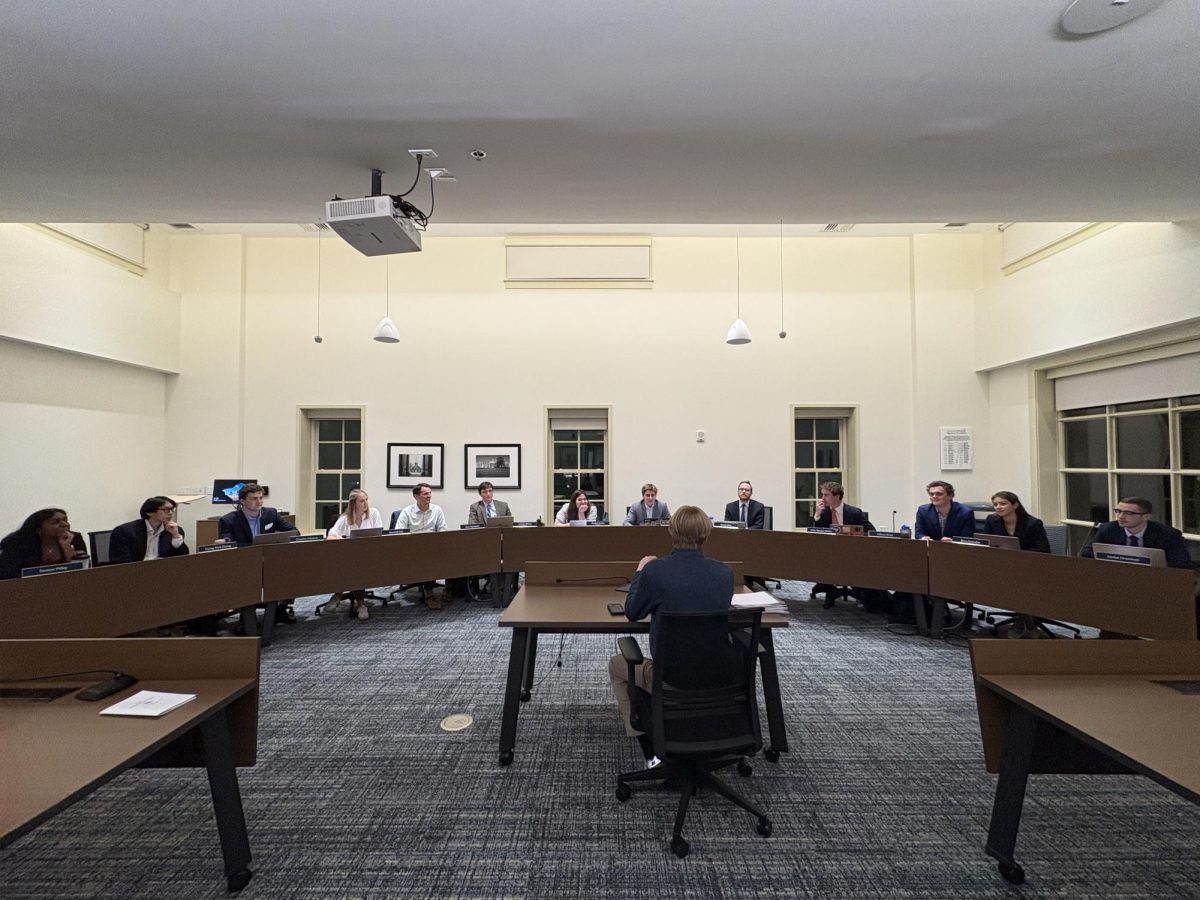


The Presidential Search Committee hosted two listening sessions to hear from Washington and Lee students about what they would like to see in the next president. Students voiced concerns about Greek life, the Honor System and the current state of the university.
“The purpose of these sessions is to try to get every area on campus involved, so they have a voice that matters, so we can feel like we have a comprehensive profile when we are trying to figure out which candidate will get the job done well,” said John Beekman Youngblood, ’27, a member of the President Search Committee and vice president of the Executive Committee.
The listening sessions are part of the “definition stage,” stage two of the committee’s four-stage plan to hire a new president, according to the website.
“We don’t want to comment, we want to listen as much as possible,” said Sally Stone Richmond, the vice president for admissions and financial aid, who also is a member of the Presidential Search Committee.
Students were prompted with questions including “How is W&L positioned today?” and “What would you like to see in the next president?”
“I think we are kind of having an identity crisis,” Meaghan Endres, ’26, the president of the Executive Committee, said at the listening session. “We are either a school that is very proud of the fact that we are incredibly Greek-oriented or a school that dances around it.”
Endres said that Greek life is a large part of what makes Washington and Lee unique. She said she loves that students can have incredible academic opportunities while getting to experience Greek life and have fun, but she is scared that the university is trying to suppress Greek life on campus. Two fraternities have been kicked off campus in her four years at the university, she said.
Julian Beaujeu-Dufour, ’26, a senior EC representative, agreed with Endres, saying that Greek life makes Washington and Lee special and is a big reason why alumni are so invested in the university.
“If I didn’t want Greek life or the honor system, I would’ve gone to any other liberal arts school,” said Beaujeu-Dufour. “It’s part of what makes us unique and we shouldn’t be ignoring that.”
Beaujeu-Dufour said that since Greek life participation is so high — 70-80% of the student population — Washington and Lee is very different from a big SEC school, where fraternities and sororities are very exclusive. He said instead of getting rid of Greek life, the school should work to make it more inclusive so everyone can find a place.
Marshall Wilt, ’26, the other senior EC representative, said incoming students should be better informed about the Honor System.
“I am surprised by the amount of students who have come in the past few years and did not know much about single sanction or the Honor System,” said Wilt. “I think the more transparent and upfront we can be about how important the honor system is, the better we will be as a university.”
The members of the Executive Committee were outspoken about how the single sanction has been “up in the air” this past semester.
“I think having someone who is willing to say, ‘Honor is who we are. Single sanction is who we are,’” said Endres.
Other students who are not on the EC agreed. “I think it is fair to say that Greek life and the Honor System are two of the most important parts of our identity,” said Anderson Walker, ’28. “We have an identity that everyone knows and respects.”
Students also said that they would like more transparency and communication from the school administration when decisions are made.
Will Moore, ’28, proposed having student liaisons as an intermediary between the administration and students.
Jack McClure, ’26, also said he wanted more explanation from the administration about big changes, such as when the minimum amount of swipes in the required meal plan increased.
“I’d like to see the university better communicate the reasoning behind these decisions that impact a large number of students,” McClure said.
Students also talked about preserving the university’s liberal arts core.
Endres said the humanities are important and proposed adding more requirements for students to take courses in arts and humanities. Students also pointed out that the commerce, economics and politics majors at the Williams School get more attention and resources than other departments.
“Yes, all of those majors go and get great jobs and make great money, but we can’t lose sight that arts and humanities enrich who we are as students and academics and lifelong learners,” she said.
Wilt said she thinks there can be a middle ground, where students take classes that align with their interests and passions to figure out their major over their first two years, instead of simply wanting to become an investment banker and being an accounting major. She said she would love to see more support and guidance for first years and sophomores as they pick their major.
Wilt also said she appreciated President Dudley’s visibility on campus. Many students echoed the importance of visibility and listening to adapt to the needs and priorities of the student population.
Will Knight, ’26, said that he worries about bringing in a president who has extremely firm stances, as a liberal arts institution is meant to encourage engagement with differing ideals.
Caden Brousseau, ’27, said the president needs to embody the university’s core values. “I think it is important for the next president to strike a balance between trying to attract new people and also staying true to what W&L is,” Brousseau said.“After all, if you try to please everyone, you please no one.”
Bryn Gonzales, ’28, wrapped up the conversation. She said she thinks the strongest stance the new president should have is a commitment to being able to listen and represent the student body as a whole.
“The Honor System is a system, not a code, because it best represents what the student body thinks at that time,” Gonzalez said. “I think that a president that has that same kind of mindset is going to best fit the kind of university we are.”
Twenty-four students were in attendance for the second session. Sam Flores, ’28, pointed out the attendance, questioning student involvement.
“I think looking at what’s in front of me right now, this is a pretty big decision that’s being made and there’s less than 30 students here right now,” he said. “That might say something about a lack of W&L’s involvement in trying to get students to care about long-term mission.”
Youngblood, the only student on the search committee, took notes throughout the entire session. He said he has been to many, if not all, of the listening sessions so far. Other listening sessions have been held for alumni, parents and faculty.
“I hear something new every time,” he said. “There are a lot of very similar themes articulated in different ways.”
The hearings were March 10 and March 17 in Leyburn Library. Four members of the 17-member committee attended the second listening session. The members in attendance were Richmond, Youngblood, Professor Lloyd Tanlu and Professor Aliaa Bassiouny. Nine trustees, five professors, two administrators and one student are on the search committee.
Youngblood said there are three or four more listening sessions scheduled in the following weeks with different groups of interest from the Washington and Lee community.
The next stage to the search process is “discovery,” when the committee plans to recruit, review and evaluate candidate applications and begin to conduct preliminary interviews.